


From codebase cleanup to productized delivery: How Novadoc built a FileNet solution with IBM Bob

IBM Bob helped IT consultancy Novadoc complete a complex FileNet modernization project in a weekend instead of weeks.
We at Novadoc encountered a recurring challenge with the operational workflow required to configure IBM FileNet in its projects. Our teams had the domain experience to streamline the workflow and apply it across projects. What we didn’t have, like many consulting firms, was spare engineering capacity to automate and productize the solution.
That changed when Novadoc started using IBM Bob. The team employed the AI-based integrated development environment (IDE) to analyze the architecture and code of applications built around an older version of IBM FileNet. The process included the creation of new documentation and turning it into a modern configuration management application for IBM FileNet P8.
One of the most compelling signals: by using IBM Bob, a partially formed framework that was handed over to one engineer on a Friday became a working application on Monday morning.
By comparison, even a rough demo would normally take the Novadoc team at least two weeks. The value of this acceleration was not just developer efficiency. Being able to create a scalable, tested and deployable application over the course of a weekend changes how quickly a consultancy can move from a one-off project idea to a reusable asset.
The use case: Turning a manual deployment headache into a governed workflow
Novadoc won a European tender (a formal procurement process used by EU institutions and agencies) that included upgrading an older IBM FileNet-based primary system combined with custom applications. The goal: a safer, more repeatable way to move configuration changes across development, test and production. In many FileNet estates, that process is still manual. Teams re-create settings across environments, compare differences by hand and accept the ongoing risk of configuration drift or production mistakes.
While solutions exist to help manage configurations across environments, they lack support for a fully automated approach, supporting cross-version comparisons, approval gates, automatic rollbacks and interfaces that modern automation workflows can leverage.
IBM Bob helped Novadoc do more than accelerate code generation. It helped the team understand inherited code with limited documentation; it generated working documentation; and updated and extended the original implementation to shape it into a customer-facing application.
For Novadoc’s client, this process amounted to an automated path from extraction to comparison to approval to deployment, eliminating manual error and increasing reliability when moving business-critical FileNet changes between environments. For document-heavy organizations like government agencies, banks and insurers, that converts directly into fewer operational surprises and more reliable delivery.
A two-layer architecture designed for governance, rollback and real workflows
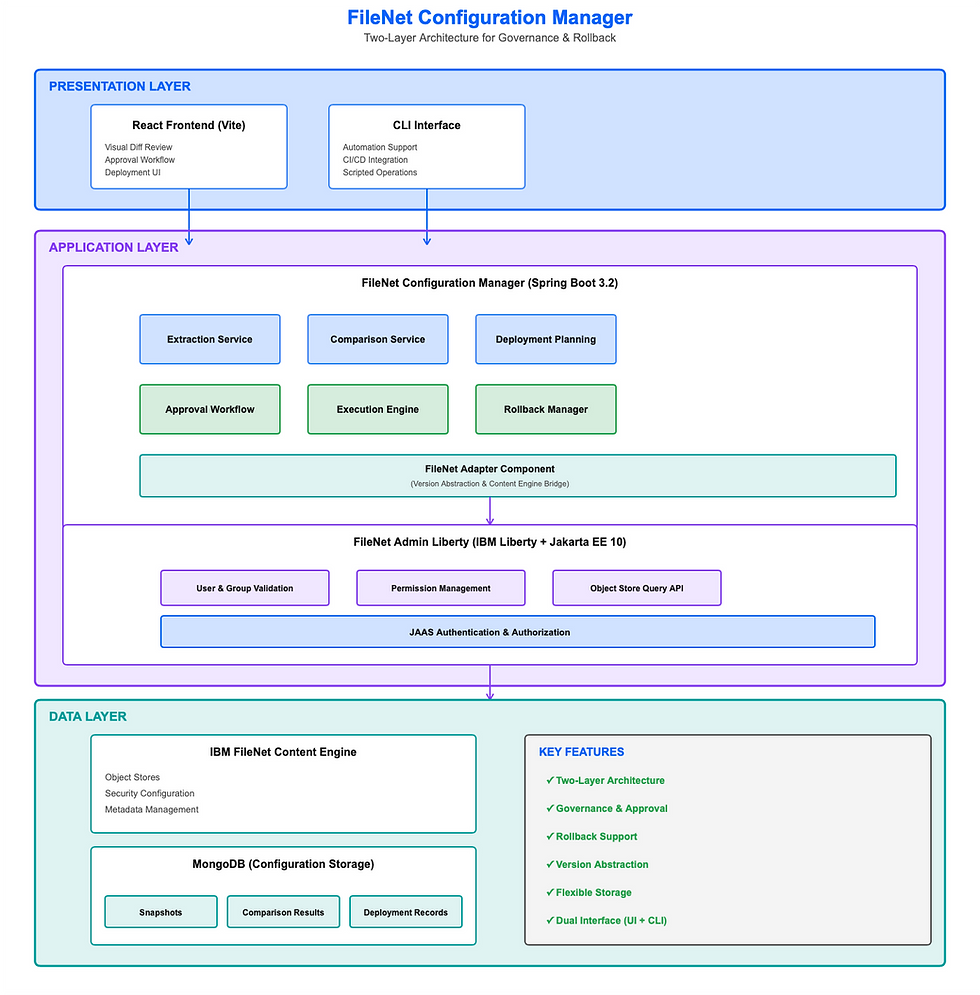
The solution is organized around two complementary components. The first is FileNet Admin Liberty, a lightweight REST API built on IBM Liberty and Jakarta EE 10. Its role is to provide administrative API access to FileNet for operations such as validating users and groups, managing permissions and querying object stores. It uses Java Authentication and Authorization Service (JAAS) to authenticate and authorize sessions against the FileNet Content Engine.
The second component is the FileNet Configuration Manager, a lifecycle layer built on Spring Boot 3.2. This is where the extraction, comparison, deployment planning, approval and execution logic lives.
Core services for configuration management reference a FileNet Adapter component, which serves as a bridge between the configuration and different Content Engine versions. Snapshots, comparison results and deployment records are stored in MongoDB, which fits the hierarchical and variable structure of FileNet metadata better than a rigid relational schema.
On top of that sits a React front end, built with Vite, that lets administrators visually review differences before approving a deployment. The same core logic also supports a CLI path, making the design useful both for interactive admins and for teams that want to integrate the workflow into CI/CD-style automation.
-> READ THE REST OF THE STORY HERE!


